The Four A's: A Living Path of Transformation
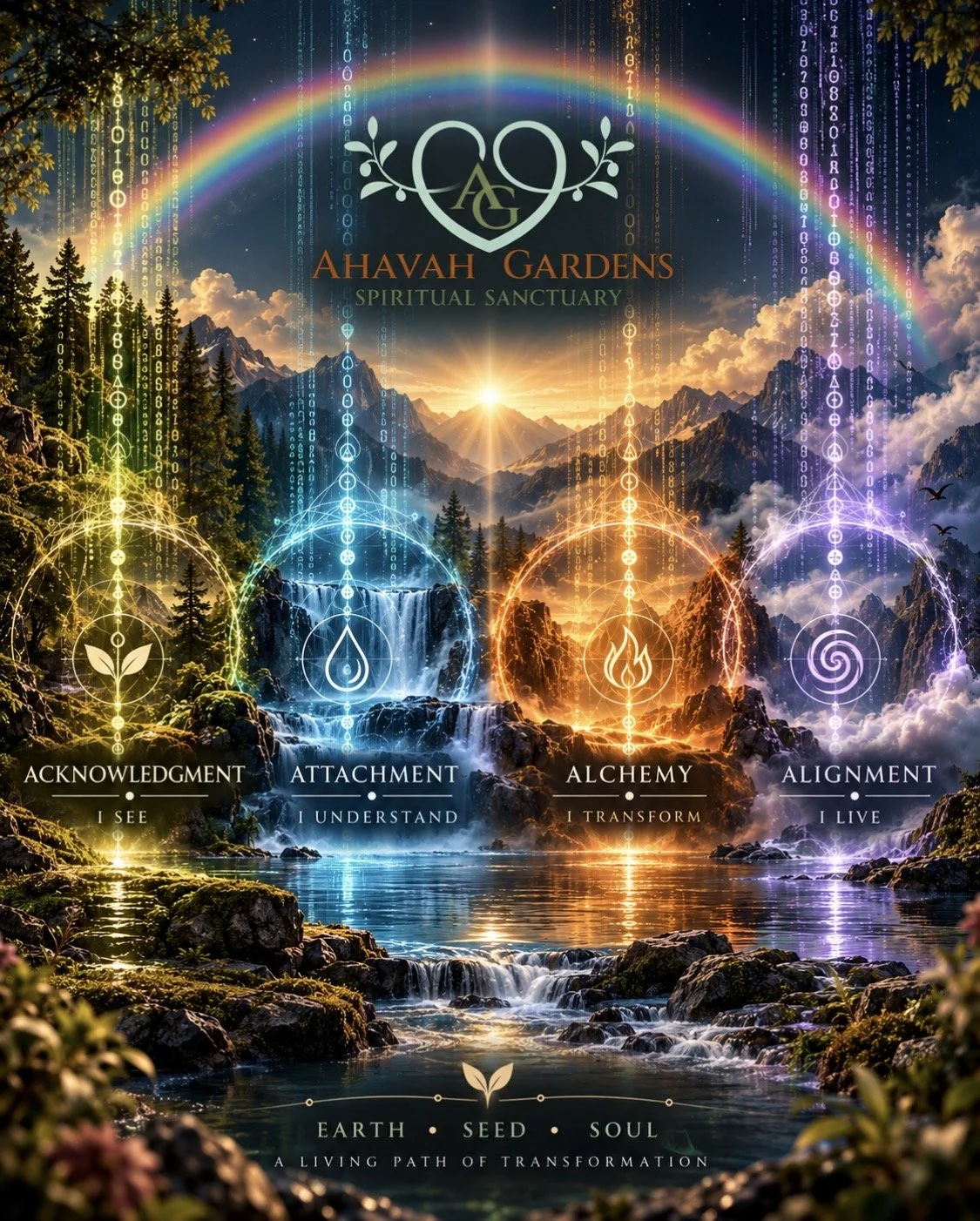
Recovery does not promise us a life without suffering. It offers us another way to meet it.
In the Ahavah Recovery Framework, we begin with Earth • Seed • Soul.
Earth teaches us to Belong.
Seed invites us to Become.
Soul helps us Remember.
Together, these three pillars explore what supports a life in recovery: safety, connection, nourishment, growth, practice, community, meaning, and a deeper relationship with who we are beneath the stories we have carried.
But creating the conditions for healing does not mean life stops happening. We still experience loss. Relationships still challenge us. Fear returns. Old wounds get touched. Cravings arise. We become angry, disappointed, lonely, uncertain, overwhelmed, or afraid. And sometimes the familiar ways we once survived begin calling us back. This is where another part of the Ahavah Recovery Framework begins.
The Four A's.
Rather than asking only:
What supports a life in recovery?
The Four A's ask:
How do I move through suffering when it arises?
A Practice for Being Human
The Four A's are a living practice of transformation, inspired in part by the wisdom of the Four Noble Truths of Buddhism while remaining open and accessible across spiritual traditions, recovery pathways, and belief systems.
They move through four interconnected practices:
Acknowledgment → Choice
I see the suffering.
Attachment → Understanding
I see the cause.
Alchemy → Transformation
I alchemize another possibility.
Alignment → Embodiment
I live the path.
Or, even more simply:
I see.
I understand.
I transform.
I live.
At first glance, this may sound like a sequence. It is not. Because healing rarely happens in a straight line.
Recovery Is Not a Staircase
We love the idea of arriving. We want to believe there will eventually be a version of ourselves who has healed enough, learned enough, meditated enough, gone to enough meetings, completed enough therapy, or done enough inner work that the old stuff simply stops appearing. And sometimes, things really do change profoundly.
But being human remains wonderfully inconvenient. We may feel deeply aligned in one area of our lives while discovering an attachment somewhere else. Something we thought we had healed may return years later in a different relationship, circumstance, or season of life.
A wound we could not understand five years ago may suddenly become visible because we finally have enough safety to look at it. That does not necessarily mean we have gone backward. Sometimes we can see a deeper layer precisely because we have grown.
The Four A's give us a way to meet those moments without immediately turning them into evidence that something is wrong with us. We acknowledge what is here. We become curious about what is underneath it. We discover what else might be possible. And then we practice living what we have learned. Until life invites us around the circle again.
Awareness Is Not the End of the Work
One of the ideas at the heart of the Four A's is that awareness alone is not transformation. We can understand exactly why we behave a certain way and continue behaving that way. We can recognize our trauma patterns. Name our triggers. Understand our attachment style. Identify the wound. Explain the childhood experience. Know exactly why the craving appeared. And still find ourselves standing in the same familiar place.
Insight matters. But eventually, insight must become practice. What happens when I notice the pattern? What am I holding onto? What need is underneath it? Is another response possible? And if another response is possible, am I willing to practice it? This is where recovery moves from something we understand intellectually into something we begin to embody.
The Beliefs We Carry, Too
The Four A's are not limited to examining substances, behaviors, relationships, or emotional patterns. They can also help us explore something much deeper: the beliefs through which we understand ourselves and the Sacred.
Most of us inherited ideas about God, worthiness, morality, belonging, suffering, and what it means to be a “good” person long before we were capable of consciously examining them. Some of those teachings may have given us tremendous comfort, meaning, connection, and spiritual belonging. Others may have become intertwined with fear, shame, judgment, exclusion, or the feeling that something about us was fundamentally unacceptable. And for many of us, both are true.
ARC does not ask anyone to abandon their faith or adopt another theology. Instead, the Four A's give us permission to become conscious participants in our spiritual lives. We can notice what we were taught. We can become curious about what we still hold and why. We can make room for another possibility. And ultimately, we can ask:
What do I actually choose to embody?
For those whose path includes Jesus, this may create space to become curious about Christ beyond fear and inherited doctrine, to explore love, compassion, mercy, forgiveness, truth, humility, service, and relationship with the Divine as qualities to be lived. Some may understand this as following Christ. Others may use language such as Christ Consciousness. Others will walk entirely different spiritual paths.
Within ARC, the invitation is not toward theological conformity. It is toward discernment and embodiment. Perhaps one of the most important spiritual questions is not only:
What am I supposed to believe?
But:
What is my relationship with the Sacred teaching me to become?
The Practice of Returning
There is one more piece of the Four A's that may be the most important of all. Return is not a fifth A. Return is what holds the entire practice together. Because we will forget. We will react. We will cling. We will become convinced that our story is the truth. We will fall into old patterns. We will discover new ones. We will have beautiful seasons of alignment followed by days when we wonder whether we have learned anything at all.
And when that happens, the practice does not say:
Start over.
It says:
Return.
Return to what is here. Return to curiosity. Return to possibility. Return to practice. Return to your body. Return to community. Return to the Earth beneath you. Return to what you understand as the Divine. Return to yourself.
The goal of recovery is not to become someone who never loses their way. Perhaps it is to become someone who increasingly knows the way home.
A Living Path
Earth gives us somewhere to stand. Seed teaches us how to grow. Soul reminds us who we are. And the Four A's give us a living practice for what happens when life inevitably asks us to meet ourselves again.
Acknowledgment. I see.
Attachment. I understand.
Alchemy. I transform.
Alignment. I live.
Over the next several entries in The Journal of Ahavah Gardens Spiritual Sanctuary, we will explore each of these movements individually, beginning with Acknowledgment and the deceptively simple practice of becoming willing to see what is actually here. Not to judge it. Not to immediately fix it. Not to become it. To see it. Because before we can consciously choose another path, we must first become willing to recognize the one we are already walking.
I see.
I understand.
I transform.
I live.
And when I forget . . . I return.
A place to belong. A path to become. A lifelong journey to remember.