
Psychedelics, Gods, and the Sacred
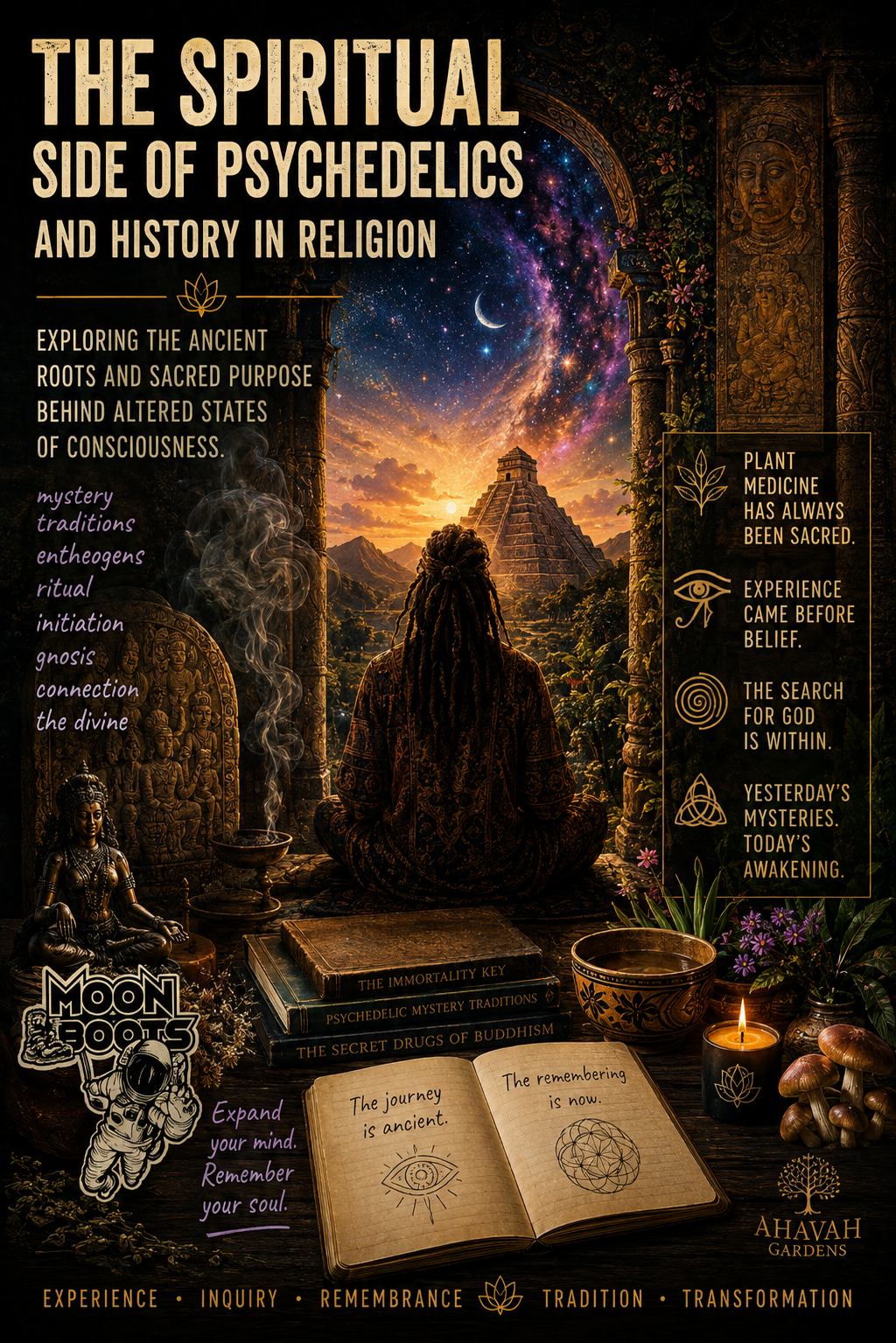
Did the Experience Come Before the Religion?
For as long as human beings have been asking questions about existence, we have searched for ways to reach beyond the boundaries of ordinary consciousness. We have prayed, fasted, meditated, danced, chanted, controlled our breath, sat alone in caves and wilderness, deprived ourselves of sleep, and created elaborate rituals designed to bring us closer to something beyond ourselves. Across many cultures, we have also consumed plants, fungi, and other preparations capable of profoundly altering consciousness.
I have been thinking about this relationship a lot lately. I recently finished Mike Crowley's The Secret Drugs of Buddhism, which sent me back into some of the ideas I encountered in Brian Muraresku's The Immortality Key and Thomas Hatsis's Psychedelic Mystery Traditions. The three books approach the subject differently, and some of the theories they explore remain controversial, but together they raise a question I find difficult to ignore: What role have altered states of consciousness played in humanity's understanding of the divine?
I am not suggesting that psychedelics created religion, nor do I think thousands of years of spiritual traditions can be reduced to people taking drugs and misunderstanding what happened to them. I am interested in a more nuanced possibility. What if, at least sometimes, the experience came before the theology? Before there was scripture, perhaps someone experienced something they could not explain. Before there was an image of a deity, perhaps someone encountered something. Before there was a doctrine about union with God, perhaps someone experienced the dissolution of the boundary between themselves and everything else.
Then they tried to describe it.
The Mysteries of Ancient Greece
One of the most fascinating places to explore this possibility is ancient Greece. For nearly two thousand years, people participated in the Eleusinian Mysteries, secret religious rites centered around Demeter and Persephone. The mythology itself revolved around descent, death, return, and rebirth. Initiates underwent preparation and fasting before eventually consuming a ceremonial beverage called kykeon, made from water, barley, and mint according to the ancient Homeric Hymn to Demeter. What happened during the central initiation was guarded with extraordinary secrecy.
For decades, one controversial explanation for the profound experiences associated with Eleusis has been the possibility that the barley used in kykeon was affected by ergot, a fungus that grows on cereal grains and produces lysergic acid alkaloids. The connection immediately attracts attention because these compounds belong to the same broad chemical family that eventually led to the development of LSD. This does not mean that ancient Greeks were taking LSD, and it certainly does not establish that kykeon was psychedelic. It does, however, raise an intriguing possibility about the pharmacology of the ancient sacrament.
That possibility became considerably more interesting in 2026. Researchers publishing in Scientific Reports experimentally investigated whether ergot could be processed using technology available in antiquity in a way that transformed some of its dangerous alkaloids into psychoactive lysergic acid amides. Using an alkaline preparation, they demonstrated the conversion of toxic ergopeptides into lysergic acid amide [LSA] and isolysergic acid amide. The experiment does not prove that the priestesses of Eleusis actually used this method or that psychedelic ergot was present in kykeon. What it does demonstrate is that an ancient method capable of producing such a preparation was chemically possible.
That distinction matters to me. There is a tendency in conversations about psychedelics and ancient religion to turn an intriguing hypothesis into established history. I don't think we need to do that. The mystery is interesting enough on its own. We know that people underwent an initiation that profoundly affected how they understood death and the afterlife. We know that a sacramental drink was central to the ritual. Now we know that at least one proposed psychedelic mechanism was chemically possible. What we do not know is exactly what happened inside that temple.
In some ways, that uncertainty is fitting.
When Wine Was More Than Wine
The ancient Mediterranean also challenges our modern assumptions about what people meant when they spoke about wine. We tend to imagine something resembling the bottle we might open at dinner, but ancient wines could be combined with herbs, medicines, resins, and other botanical ingredients. Thomas Hatsis explores this wider history extensively in Psychedelic Mystery Traditions, including entheogenic practices associated with Eleusis, Dionysian traditions, Gnostic communities, magical practices, and forms of early Christianity.
The Dionysian traditions are particularly interesting because Dionysus was much more than simply a god of wine. The religious world surrounding Dionysus involved ecstasy, possession, transformation, madness, liberation, and the temporary disruption of ordinary identity. Even the concept of ecstasy points toward the experience of moving outside one's ordinary state of self.
For anyone familiar with powerful psychedelic or mystical states, there is something recognizable here. One of the most striking features of these experiences is precisely this loosening of ordinary identity. The person can temporarily cease to experience themselves as the separate, bounded individual they normally assume themselves to be. That can manifest as union with nature, communion with God, identification with the entire universe, or complete ego dissolution.
None of this proves that Dionysian religion was fundamentally psychedelic. Religious ritual, dance, music, collective movement, fasting, sleep deprivation, and ordinary alcohol can themselves profoundly alter consciousness. But it reminds us that ancient religion was often experiential in ways that modern discussions of belief can overlook. These traditions were not necessarily asking someone merely to believe something about the divine. They were creating circumstances in which the participant might experience something.
Psychedelics and Early Christianity
This is where Brian Muraresku's The Immortality Key enters especially provocative territory. Muraresku investigates whether some of the sacramental practices found throughout the ancient Mediterranean mystery traditions could have survived, transformed, or influenced communities around the emergence of Christianity.
The possibility is fascinating because Christianity eventually places a consumed sacrament at the very center of its religious life. Bread and wine become the body and blood of Christ, and consuming them becomes an act of communion with the divine. The larger Christian narrative revolves around death, transformation, resurrection, and eternal life, themes that also appear throughout older Mediterranean mystery traditions.
The hypothesis that some early Christian groups consumed psychoactive Eucharistic preparations remains controversial, and the available evidence does not justify declaring that early Christianity was a psychedelic religion. Hatsis likewise explores psychedelic practices within pagan and Christian magical traditions without reducing Christianity itself to a single pharmacological explanation.
What interests me is the larger question. If some ancient religious sacraments did contain consciousness-altering plants, would that make the experiences they produced less spiritual?
Our modern culture tends to create a sharp boundary between a "genuine" mystical experience and a chemically facilitated one. I am not convinced that boundary is as obvious as we sometimes make it. If meditation, breathwork, fasting, chanting, drumming, sensory deprivation, or prolonged prayer changes the chemistry and activity of the brain, we generally don't conclude that the resulting spiritual experience is therefore meaningless. Why should a plant or fungus automatically make the experience spiritually invalid?
Perhaps the better question is not simply what produced the state, but what the person encountered within it and how the experience changed them afterward.
Soma and the Ancient Search for Immortality
The relationship between sacred substances and religion becomes even more explicit when we move eastward into ancient India. The Rig Veda, one of humanity's oldest surviving sacred texts, repeatedly celebrates Soma, a mysterious substance that is simultaneously described as a preparation, a sacrament, and something divine.
The identity of Soma remains one of the enduring mysteries of religious history. Numerous plants and fungi have been proposed, and there is no universally accepted botanical identification. What matters for this discussion is that an ancient religious tradition placed the consumption of a sacred substance alongside experiences of divine contact, illumination, and immortality.
This is the thread Mike Crowley follows in The Secret Drugs of Buddhism. Crowley traces what he argues may be a historical evolution from the Vedic Soma tradition into the later concept of amrita, the nectar of immortality or deathlessness that became important within Vajrayāna Buddhism. Amrita appears in Buddhist texts, rituals, visualization practices, and religious iconography. Crowley's central and much more controversial argument is that some early forms of Buddhist amrita may have contained psychoactive ingredients, whereas the preparations called amrita in contemporary Vajrayāna practice are not psychedelic.
This is another place where I think distinguishing evidence from interpretation is important. Amrita's role within Vajrayāna Buddhism is well established. Crowley's attempt to reconstruct an entheogenic history for early amrita is a historical thesis, not a universally accepted account of Buddhist origins. Yet reading his work opened another door for me because it caused me to look differently at the extraordinary religious imagery surrounding Vajrayāna Buddhism.
Vajrayogini, Amrita, and the Language of Transformation
One of the figures that especially caught my attention is Vajrayogini, a feminine tantric Buddhist deity associated with profound transformation and enlightened awareness. In traditional imagery she can appear with a skull cup, which may contain blood or amrita depending upon the particular representation and interpretation.
Even without accepting an entheogenic interpretation, the symbolism is remarkable. The skull is an unmistakable symbol of mortality, yet it becomes a vessel associated with transformation and deathlessness. Rather than escaping death, the imagery seems to confront it directly and transform our relationship with it.
The wrathful deities of Vajrayāna Buddhism fascinated me for similar reasons. To someone unfamiliar with the tradition, these beings can appear frightening or even demonic. They can have fangs, flames, skulls, weapons, multiple limbs, and terrifying expressions. Yet their appearance does not necessarily signify evil. Within Buddhist traditions, a wrathful form can express enlightened awareness, protection, or the fierce destruction of ignorance and attachment.
I find this particularly interesting through the lens of psychedelic experience because the sacred does not always arrive looking peaceful. Anyone who has spent enough time exploring these states knows that an experience can become frightening, overwhelming, or seemingly hostile. Sometimes resistance intensifies that experience, while surrender reveals something entirely different underneath it. What initially appeared monstrous can become protective or instructional. What seemed to be destroying us may actually be dismantling something we no longer need.
I am not claiming that Buddhist practitioners invented wrathful deities after psychedelic experiences. That would go far beyond the historical evidence. What interests me is the recurring human experience beneath the imagery. Across very different contexts, transformation is often represented not only through beauty and light, but through death, terror, dissolution, and rebirth.
Where Do the Gods Come From?
This brings me to the question that has followed me through these books: Where do these beings come from?
Hindu and Buddhist traditions contain extraordinarily detailed descriptions of gods, deities, bodhisattvas, protectors, and other nonordinary beings. They have recognizable appearances, colors, personalities, objects, gestures, functions, and realms. Western religions have angels, demons, saints, and divine manifestations. Indigenous traditions throughout the world describe spirits, ancestors, animal intelligences, and beings associated with particular plants and places.
Then we arrive in modern psychedelic culture and hear people describing entities.
The language has changed, but I am not certain the underlying question has.
One contemporary account circulating online recently captured my attention. A Muslim man reportedly described taking DMT and encountering an elephant-headed being that he subsequently identified as the Hindu deity Ganesh, while claiming that he had not previously known who Ganesh was. I find accounts like this fascinating, but they require some humility. A personal story cannot establish that someone had never encountered an image of Ganesh consciously or unconsciously, nor can it demonstrate that Ganesh objectively exists as an independent being.
Yet it raises a worthwhile question. Why do people sometimes encounter imagery, beings, or archetypes during psychedelic states that seem foreign to their conscious religious and cultural framework?
There are plenty of possible explanations. Human memory is extraordinarily complex. We encounter thousands of images throughout our lives that we later cannot consciously recall. Human brains also share common structures, which may make certain patterns and archetypal forms more likely to arise across individuals.
But there are other possibilities too, and I think we should be able to explore them without pretending we already know the answer.
My First Experience of God
For me, this isn't simply an academic question. Psychedelics played an important role in shaping my spirituality long before I began reading about the possible relationship between entheogens and ancient religion.
My first experience with LSD gave me something I had never received from an intellectual discussion about spirituality: a direct and overwhelming experience of the connectedness of everything.
Saying "everything is connected" can sound almost cliché now, particularly within psychedelic culture. Experiencing it was entirely different. I did not arrive at connectedness as an idea. It felt self-evident. The boundaries I normally perceived between myself, other people, nature, and existence itself seemed far less fundamental than I had assumed.
Eventually, the word that made the most sense to me for what I experienced was God.
I don't mean God exclusively in the conventional image of a separate being somewhere outside creation. What I experienced felt closer to God as the totality of existence, the underlying consciousness or unity within which everything participates. Rather than discovering a new religious doctrine, I was left with a question that has followed me ever since: What if separateness is not as fundamental as it appears to be?
That experience changed the way I approached spirituality because belief was no longer the only doorway. I had experienced something. I still had to interpret that experience, and interpretation is always influenced by culture, language, memory, and expectation, but the experience itself came first.
That distinction has become increasingly important to me.
Bufo and the Dissolution of Self
My experiences with Bufo, or 5-MeO-DMT, eventually took that question much further.
LSD allowed me to experience myself as profoundly connected with everything around me. In some of my deepest Bufo experiences, even the distinction required for "connection" disappeared. There was no longer a separate me that was connected to everything else because the ordinary structure of individual identity had dissolved.
There was no Benny standing outside of consciousness and observing it. The familiar collection of memories, roles, concerns, relationships, history, and personality that I normally call myself was absent. Yet there was still something I can only describe as awareness or pure consciousness.
Trying to put that experience into language is inherently difficult because language depends upon distinctions. A subject experiences an object. I see something. I feel something. I encounter God. But what happens when the distinction between the person having the experience and the thing being experienced disappears?
For me, that profoundly changed the spiritual question. Instead of simply asking whether I believed in God, I became fascinated by the nature of the consciousness asking the question in the first place. If my ordinary identity can disappear while awareness remains, what exactly is consciousness?
I do not pretend to know the answer. But I can no longer approach the question as though it were purely philosophical.
DMT and the Experience of Otherness
DMT has shown me what feels like another side of the same mystery. If Bufo repeatedly takes me toward oneness, DMT has sometimes taken me toward profound otherness.
I have experienced spaces that seemed populated by spirits, intelligences, or entities. These experiences have contained a sense of presence and interaction that is difficult for me to dismiss as simply seeing unusual colors and shapes. At times it has felt less like watching my mind produce imagery and more like entering somewhere that was already there.
Some of these encounters have felt to me as though they involve beings connected to another dimension of reality. I sometimes use the language of a fourth dimension because it gives me a conceptual framework for describing something that seems to exist outside our ordinary three-dimensional experience. I do not mean that as a scientific claim. I cannot measure the realm, demonstrate its location, or prove that the beings I encountered exist independently of my nervous system.
What I can say is that the experiences themselves were real experiences, and they have become part of the foundation of my spiritual beliefs.
That distinction matters. I do not need to claim that I have scientifically demonstrated the existence of interdimensional spirits in order to acknowledge that encounters with what felt like autonomous intelligences profoundly changed the way I understand consciousness and reality.
Have We Been Encountering These Archetypes All Along?
This is where the historical material and my personal experiences begin to come together.
Soma, amrita, Vajrayogini, wrathful deities, Ganesh, angels, spirits, ancestors, and DMT entities emerge from very different cultures and cannot simply be collapsed into one category. Each belongs to its own complex religious and cultural history. Yet I increasingly wonder whether different traditions have sometimes encountered similar structures within extraordinary states of consciousness and given them different names.
One possibility is neurological. Human beings share remarkably similar brains, so perhaps when ordinary perception is disrupted, those brains generate recurring forms. Another possibility is psychological. Carl Jung's concept of archetypes and the collective unconscious offers one framework for understanding why certain symbolic structures might repeatedly emerge across individuals and cultures.
My own spiritual view leaves room for something beyond those explanations.
I wonder whether some of these archetypes were experienced before they were described.
Imagine someone thousands of years ago undergoing an extraordinary state of consciousness, whether through meditation, fasting, ritual, illness, dreaming, psychoactive plants, or some combination of them. They encounter something that feels autonomous. Perhaps it has a particular appearance or communicates something profound. They return and attempt to describe what happened. Someone paints it. Someone carves it. The story is repeated. Others recognize something within the description. Ritual develops around the encounter. Generations pass, imagery becomes standardized, mythology grows around it, and eventually theology explains what the being is and what it means.
Thousands of years later, we call it a deity.
But perhaps somewhere beneath the deity was originally an encounter.
That possibility has increasingly become part of my blended spiritual view. I do not believe that one religious tradition necessarily possesses the entire map of reality. I wonder instead whether many traditions have encountered pieces of something larger and interpreted those encounters through their own cultural languages. One person encounters an angel, another a bodhisattva, another a spirit, another an ancestor, another a Hindu deity, and a modern psychonaut might simply call it an entity.
That does not mean they are necessarily encountering the same objective beings. They could be psychological archetypes, neurological phenomena, independent intelligences, manifestations of consciousness itself, or something for which our current categories are inadequate.
I am increasingly comfortable leaving that question open.
What Does It Mean for Something to Be Real?
Eventually, conversations like this encounter an unavoidable question: Are these experiences real?
I think "real" becomes a surprisingly complicated word when we begin talking about consciousness.
A dream is a real experience even though we do not generally believe the physical events of the dream occurred in ordinary waking reality. Love is real, fear is real, grief is real, and music can completely alter our internal state despite none of those experiences being objects we can hold in our hands.
A psychedelic encounter can profoundly transform someone's relationship with death, addiction, trauma, nature, spirituality, and other human beings regardless of how we ultimately explain the neurological mechanism behind it.
At the same time, I don't think we should use the subjective reality of these experiences as a way to avoid the larger question. When people repeatedly report apparently autonomous intelligences, experiences of unity, ego dissolution, other realms, death and rebirth, and encounters with something they describe as divine, I think we are allowed to wonder what that means.
We simply need to distinguish wondering from knowing.
There is an enormous difference between saying, "I encountered a being that felt completely independent of me," and saying, "I have scientifically proven that an interdimensional being exists." The first is an honest description of experience. The second requires evidence that we currently do not possess.
For me, spirituality can live comfortably within that uncertainty.
Did the Experience Come Before the Religion?
When I look at the history of psychedelics and religion, I am less interested in proving that a particular ancient sacrament contained a particular molecule than I am in the larger pattern. Human beings across enormous stretches of time and geography have repeatedly sought experiences that move beyond ordinary consciousness. Some traditions used plants and fungi. Others used fasting, meditation, breath, music, dance, ritual, or extreme physical practices. Many combined several of these methods.
Again and again, people returned describing remarkably powerful themes: unity, divine beings, death and rebirth, spirits, other realms, timelessness, overwhelming love, dissolution of the self, and communion with something greater than the individual.
Modern psychedelic experiences frequently contain those same themes.
Perhaps psychedelics manufacture gods. Perhaps they reveal neurological structures that humanity has interpreted as gods for thousands of years. Perhaps they allow consciousness to perceive aspects of reality that our ordinary sensory system filters out. Perhaps consciousness itself is more fundamental than we currently understand. Or perhaps all of these explanations are still too crude for whatever is actually happening.
I don't know.
What I do know is that my own experiences have made it impossible for me to dismiss the spiritual dimension of psychedelics. My first LSD experience showed me a connectedness that I eventually came to understand as God. Bufo has dissolved the distinction between myself and that larger consciousness altogether. DMT has confronted me with what felt like the opposite mystery, not the disappearance of everything into one, but encounters with apparent intelligences that seemed profoundly other.
Then I open books describing ancient people drinking sacred preparations, encountering gods, dissolving ordinary identity, contemplating deathlessness, depicting extraordinary beings, and attempting to explain realities beyond everyday perception.
I cannot help but wonder whether we are participating in something very old.
Maybe religion sometimes begins when someone tries to explain the inexplicable. Maybe mythology sometimes begins when someone tries to describe what cannot adequately be described. Maybe a deity is one culture's language for an encounter that another culture would call a spirit, an archetype, an angel, or an entity.
None of this proves what psychedelics ultimately reveal. If anything, these experiences have made me more comfortable saying that I do not know.
But they have also made me much more curious about the possibility that some of humanity's oldest spiritual traditions contain echoes of direct experiences of consciousness that we are beginning to explore again today.
Perhaps psychedelics are showing us something inside ourselves. Perhaps they are allowing us to encounter something outside ourselves.
Or perhaps the most profound possibility is that the boundary between those two was never as clear as we thought.
